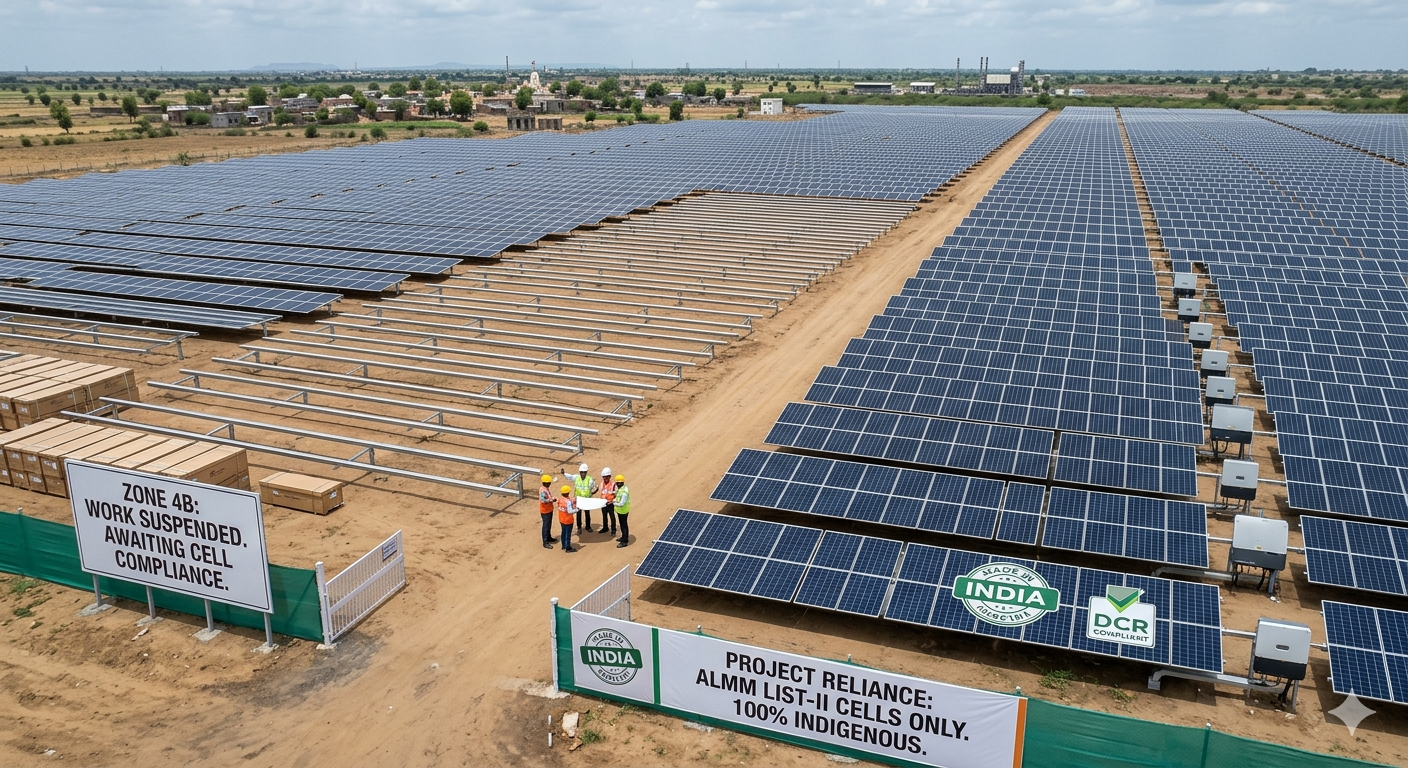
The Solar Cell Import Clampdown: Navigating India's New ALMM Reality
The Indian solar ecosystem has entered one of its most transformative periods following the enforcement of the Approved List of Models and Manufacturers (ALMM) List-II mandate for solar cells. By restricting the use of imported solar cells in eligible projects, the Ministry of New and Renewable Energy (MNRE) has accelerated India's push toward domestic manufacturing and energy security.
For years, the industry operated on a hybrid model—assembling solar modules locally while relying heavily on imported Chinese solar cells. With the new mandate now fully active, that operational framework has fundamentally changed.
While the policy strengthens India's long-term self-reliance goals, it has also created immediate challenges related to technology availability, supply chain capacity, project economics, and manufacturing competitiveness.
1. The Technology Mismatch: A Structural Challenge
The most pressing challenge facing the industry today is not simply a shortage of solar cells—it is a mismatch between manufacturing technology and available domestic capacity.
Over the last two years, the global solar market has rapidly shifted toward TOPCon (Tunnel Oxide Passivated Contact) technology due to its higher efficiency and improved energy yield.
Current Industry Reality
- Module Assembly Capacity: Approximately 89% of modern Indian module manufacturing lines are optimized for TOPCon production.
- Domestic Cell Capacity: Approved domestic capacity stands at approximately 31 GW.
- Technology Gap: More than half of the existing domestic cell capacity remains focused on older Mono PERC technology.
The result is a significant manufacturing bottleneck. India possesses substantial module assembly infrastructure but lacks sufficient domestic TOPCon cell production capacity to support growing demand.
Many manufacturers now find themselves operating advanced production lines while facing limited access to the exact cell technologies those facilities were designed to utilize.
2. Open-Market Cell Starvation
Independent module manufacturers are experiencing additional pressure due to the structure of India's solar manufacturing ecosystem.
A significant portion of domestic cell production capacity is controlled by vertically integrated industry leaders. These organizations naturally prioritize internal consumption to support their own module manufacturing and utility-scale project pipelines.
Consequently, only a limited percentage of domestically produced solar cells are available through the open market.
Impact on Independent Manufacturers
- Reduced access to domestic cell supply
- Increased procurement competition
- Potential production slowdowns
- Pressure to establish strategic supply partnerships
- Greater market consolidation among smaller manufacturers
This environment is forcing many standalone manufacturers to reconsider technology strategies, sourcing models, and long-term business plans.
3. Commercial Friction: Re-Evaluating Project Economics
The transition to domestic cell sourcing is significantly impacting project economics across commercial, industrial (C&I), and utility-scale solar projects.
| Component Sourcing | Average Market Price | Commercial Impact |
|---|---|---|
| Imported Solar Cells | ~₹5 per watt | Lower cost structure with import dependency risks |
| Domestic ALMM-Approved Cells | ~₹13 per watt | Higher procurement cost and margin pressure |
This substantial pricing difference is creating challenges for developers operating under fixed-price contracts and long-term power purchase agreements (PPAs).
Many project stakeholders are reassessing project viability, financial assumptions, procurement timelines, and commissioning schedules.
4. The Upstream Roadmap: Preparing for ALMM List-III
Industry leaders should recognize that the current cell sourcing restrictions represent only one phase of a broader strategic roadmap.
Policymakers are already laying the foundation for the next stage of localization, which is expected to expand domestic sourcing requirements further upstream into the solar manufacturing value chain.
India's Domestic Manufacturing Roadmap
- 2024–2025: Module Manufacturing Mandate
- 2026: Solar Cell Mandate (Currently Active)
- 2028: Potential Ingot & Wafer Localization Requirements
Organizations that fail to establish long-term backward integration strategies may face increasing supply chain exposure as future localization requirements are introduced.
Strategic Considerations for Industry Leaders
The solar industry is entering a new phase where supply chain resilience and domestic manufacturing partnerships are becoming as important as technology selection and project execution.
Recommended Actions
- Strengthen Vendor Due Diligence: Verify domestic content compliance and supplier capability before project commitment.
- Build Procurement Buffers: Secure supply allocations early and plan for longer lead times.
- Diversify Supplier Networks: Reduce dependency on a single source of domestic cell supply.
- Reassess Financial Models: Update project assumptions to reflect current domestic sourcing costs.
- Prepare for Future Localization: Develop strategies that anticipate upcoming manufacturing requirements.
The Executive Takeaway
India's ALMM List-II implementation marks a pivotal moment in the country's renewable energy journey. While short-term disruptions are creating challenges across the supply chain, the policy is intended to establish a stronger and more resilient domestic solar manufacturing ecosystem.
Success in this new environment will depend on procurement discipline, strategic partnerships, operational agility, and long-term investment planning.
The future competitive advantage will belong to organizations that can balance domestic compliance, technology adoption, supply chain resilience, and project economics simultaneously.
Conclusion
The solar cell import clampdown is more than a regulatory change—it represents a structural transformation of India's clean energy supply chain. While the transition may create temporary challenges, it is also accelerating investment in domestic manufacturing capabilities and strengthening long-term energy security.
For manufacturers, developers, EPC contractors, and investors, the key question is no longer whether the market will adapt, but how quickly organizations can position themselves for success in India's evolving solar landscape.