.png)
Semiconductor & Electronics Adhesives
This product line features highly specialized, 100% solvent-free polymer matrices—including one-component thermoset epoxies, rapid photo-curing acrylics, and two-component reaction systems. Formulated for excellent capillary flow, ultra-low shrinkage stress, and high volume resistivity, these materials protect sensitive silicon dies, wire bonds, and delicate passive components. They are explicitly tuned for high-speed automated dispensing equipment, maintaining sharp dot profiles, excellent thixotropic control, and zero tailing or stringing on the production line.
Advantages
- High-Speed Processing: Rapid ultraviolet (UV) polymerization or accelerated low-temperature heat curing minimizes assembly cycle times and boosts line throughput.
- Stress & Vibration Cushioning: Tailored glass transition temperatures (Tg) and balanced elongation properties absorb mechanical shock, board flexing, and drop impacts.
- CTE Matching & Thermal Stability: Formulated with advanced inorganic fillers to match the Coefficient of Thermal Expansion (CTE) of metals and ceramics, preventing solder joint fatigue during thermal cycling.
- Excellent Capillary Wetting: Low-viscosity underfills flow rapidly beneath low-clearance flip-chips and ball grid arrays (BGAs) via natural capillary action.
- High Environmental Isolation: Forms a reliable barrier against moisture, dust, salt spray, and atmospheric contaminants, ensuring long-term device durability.
Technical Characteristics
| Property | Specification Details |
|---|---|
| Chemical Base | One-Component Epoxies, Light-Curing Acrylics, or Cationic Epoxies. [cite: 1] |
| Viscosity Range | Highly versatile fluid dynamics, ranging from ultra-fluid capillary liquids (500–650 cps) to non-slump thixotropic structural pastes (140,000–270,000 cps). [cite: 1] |
| Curing Flexibility | Dual-cure (UV + Heat) mechanisms or low-temperature thermal curing (70°C to 80°C) to safeguard heat-sensitive electronic substrates. [cite: 1] |
| Electrical Insulation | High dielectric strength combined with premium volume resistivity (≥ 4.5 × 10¹⁴ Ω·cm) prevents localized cross-talk or electrical leakage. [cite: 1] |
| Purity Standards | Halogen-Free (HF) and strictly compliant with RoHS regulations, ensuring compatibility with cleanroom standards and delicate wafer environments. [cite: 1] |
Application Details
- BGA & CSP Underfill: Capillary filling and structural reinforcement for Ball Grid Arrays, Chip-Scale Packaging, and flip-chip designs.
- SMT Component Tacking: High-tack red glue formulations for holding passive components firmly in place prior to wave soldering.
- Camera Module Assembly: Active alignment of optical lens mounts, structural bonding of sensor housings, and side-light blockout processing.
- Waterproof Sealing & Potting: Deep encapsulation of electronic connector pins, automotive sensors, micro-transformers, and outdoor LED display drivers.
- FPC Reinforcement: Soft, highly flexible moisture-proof coatings designed to reinforce Flexible Printed Circuit (FPC) joints subject to continuous bending.
Application Process
Step 1: Surface Preparation Ensure all bonding surfaces are completely clean, dry, and free of flux residues, processing oils, or moisture. For highly inert or low-energy plastic substrates (e.g., LCP, Nylon), localized plasma or corona surface treatment is highly recommended to enhance wetting and bond strength. Step 2: Dispensing Setup Thaw refrigerated one-component materials completely to room temperature naturally before use (do not apply direct heat). Load the syringe into your automated pneumatic, volumetric, or jet-dispensing system. Adjust pressure and nozzle configurations to achieve your target dot or bead geometry without entrapping air bubbles. Step 3: Curing Protocol For Thermal-Curing Epoxies: Pass assemblies through a calibrated inline reflow oven or batch oven. Ensure the assembly experiences the specified heat profile (e.g., 80 C for 15–30 minutes or 130 C for 10 minutes) to reach full cross-linking density. For UV/Light-Curing Adhesives: Expose the adhesive layer directly to a UV mercury lamp or monochromatic LED array (365nm, 395nm, or 405nm) with a minimum energy density of 1,500–3,000 mJ/cm2 for rapid, multi-second curing.
Packaging Sizes
- To fit seamlessly into modern, high-precision automated manufacturing environments, our electronics adhesives are available in industry-standard packaging:
- Precision EFD-Compatible Syringes: 10ml, 30ml, and 50ml black or clear light-shielded syringes designed for direct machine integration.
- Dual-Barrel Cartridges: 50ml side-by-side cartridges complete with static mixing nozzles for two-component potting systems.
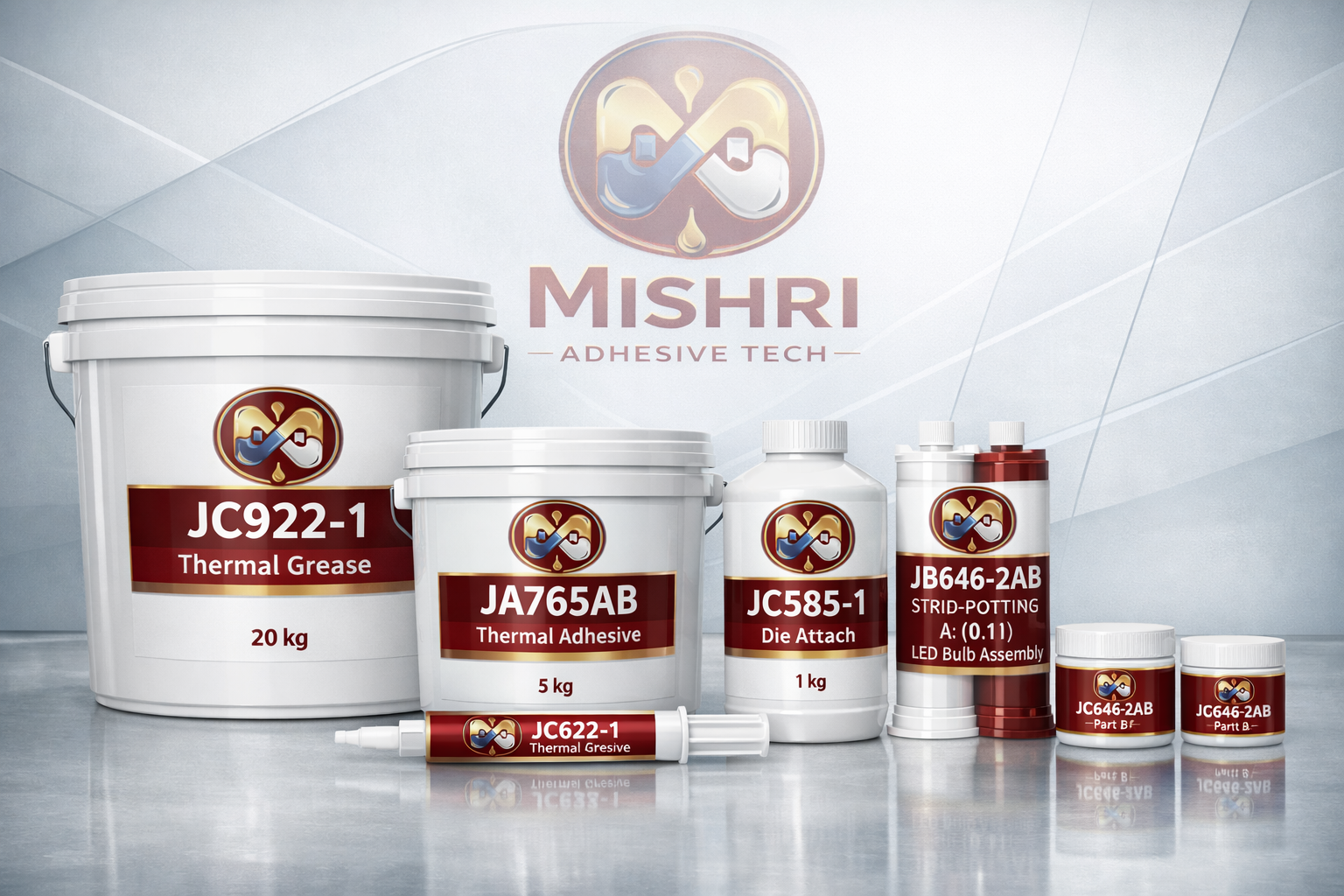
- Bulk Containers: 1kg bottles and 5kg pails for high-volume automated production lines utilizing centralized fluid pump networks.
Storage & Shelf Life
- One-Component Thermoset Epoxies: Must be stored under continuous refrigeration between -20 C and -5 C to prevent latent chemical polymerization. Under these conditions, typical shelf life is 6 months from the date of manufacture.
- Photo-Curing Adhesives: Store in their original, unopened lightproof containers in a cool, dry ambient environment between 14 C and 25 C. Keep completely away from direct sunlight or ambient factory lighting. Typical shelf life is 12 months.
- Important Handling: Frozen or refrigerated components must be allowed to stabilize at room temperature for roughly 1 to 2 hours before processing. Opening cold containers prematurely will cause atmospheric moisture to condense inside the adhesive, leading to internal voiding and degraded electrical performance.
Special Note & Safety
Exothermic Management: For two-part potting or encapsulating systems, mixing resin and hardener triggers an exothermic chemical reaction. Mixing massive bulk quantities at once accelerates this heat build-up, which drastically shortens the pot life and can cause internal boiling or bubbling. Mix only the immediate volume required for your production cycle. Viscosity Sensitivity: Fluid thixotopy and viscosity are highly dependent on the temperature of your factory floor. Ambient seasonal shifts will modify dispensing behavior. For high-yield, micro-dot electronics assembly, implementing localized temperature-controlled dispensing heads is highly recommended. Custom R&D Formulations: Recognizing that every electronic assembly line presents unique geometry and process constraints, our engineering team can fully customize any chemical structure. We can alter thixotropic indexes, implement custom fluorescent tracking colors for automated optical inspection (AOI), or modify cure profiles to match your existing equipment line.